
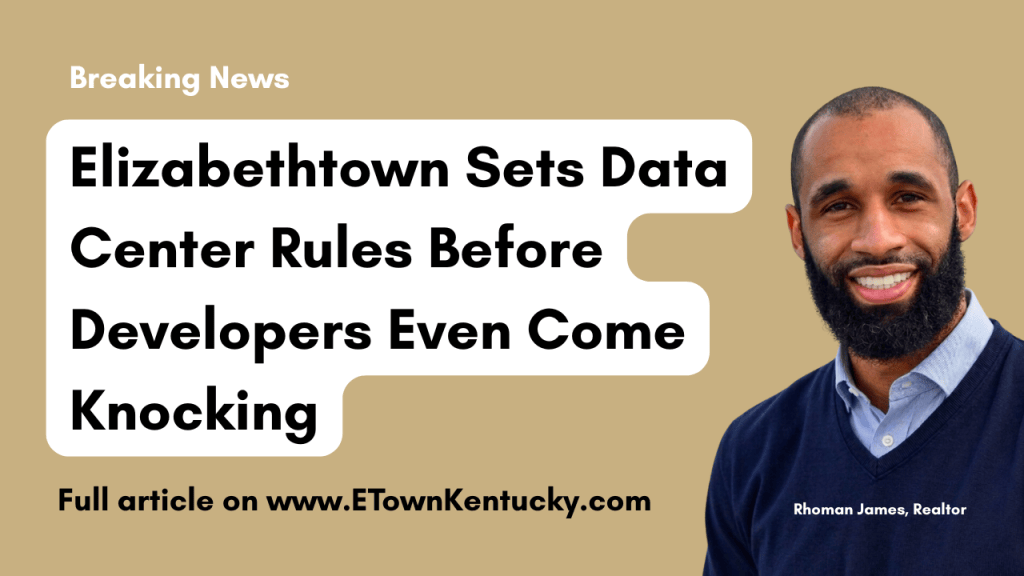
People are divided on this issue. It is good for business? Will it hurt property values? What does this mean for the future of ETown?
Elizabethtown city planners voted Monday night to restrict data centers in the city, even though no developer has actually proposed one. The new rules classify data centers as “accessory uses” only — meaning a facility can’t be built as a standalone, hyperscale operation. Instead, any data center would have to operate as a secondary use tied to another business, like a bank or an existing industrial operation, and would be capped by square footage.
The restrictions are stricter in commercial zones than in industrial areas, giving the city more flexibility where infrastructure is already built for heavier use.
Planning and Development Director Aaron Hawkins explained the city’s reasoning: rather than pass a moratorium, which he described as just delaying the issue, the city chose to put permanent regulations in place now. City officials say the move is purely proactive — not a response to any specific project or proposal.
Data Centers by the Numbers
To put Elizabethtown’s decision in context, here’s what the data actually shows about the facilities cities are trying to plan around.
Size varies enormously depending on the type of facility. The average data center covers about 100,000 square feet, but hyperscale facilities — the kind built for major cloud providers — can sprawl across as much as 10 million square feet. On the small end, some facilities take up as little as 1,000 square feet. Most industry definitions agree that a true hyperscale operation involves at least 5,000 servers, more than 10,000 square feet of space, and over 100 megawatts of power — a scale Elizabethtown’s new rules are specifically designed to keep out. Programs + 2
Water use is where things get more contentious, and more variable. A typical facility uses around 300,000 gallons of water per day for cooling, roughly what 1,000 households use. Large facilities push that much higher — up to 5 million gallons a day, comparable to the daily water demand of a town of 30,000 to 50,000 people. But cooling method matters as much as size: a fully air-cooled data center uses almost no water at all, while evaporative cooling systems drive the biggest numbers. The Network Installers + 2
Nationally, the trend is upward. U.S. data centers directly consumed 17.4 billion gallons of water in 2023, and that figure is projected to climb to between 38 and 73 billion gallons by 2028, with hyperscale facilities expected to account for roughly half of that. And while data centers make up only about 0.2% of total U.S. water use, close to 40% of them are located in already water-stressed regions — which is exactly why more than 50 cities have moved to restrict them before Elizabethtown did. MOST Policy InitiativeThe Network Installers
The takeaway: not all data centers are created equal. A small accessory facility tied to an existing business bears almost no resemblance to a hyperscale campus — which is precisely the distinction Elizabethtown’s new ordinance is built around.
Rhoman’s Take
I’ve heard both sides of this one, and honestly, they’re both right.
On one hand, data centers could be good for Etown. More business activity, more investment, more reasons for companies to look at this city instead of driving past it. That’s the kind of growth that raises property values and brings more amenities to town — things that make Etown more attractive to buyers and businesses alike.
On the other hand, people move here — and stay here — for a reason. Etown has a small-town feel that a lot of people specifically don’t want disrupted. Nobody wants to trade that identity for a facility that hums 24/7, eats up water and power, and doesn’t actually add much street-level life to the community.
I think the city threading the needle here — allowing data centers, but only as accessory uses with square footage caps — is a reasonable middle ground. It keeps the door open for the economic upside without handing over the town to a hyperscale facility nobody asked for. We’ll see how it plays out once an actual proposal comes through, but for now, this feels like Etown protecting its character while still staying open for business.
What do you think? Let me know your thoughts in the comments.

 Rhoman James, Real Estate Agent